- C - 16, Tulsi Marg, C Block, Sector 19, Noida, U.P 201301
- +91 7428 911 866
- oshina32@gmail.com
FOLLOW US:
Hair fall can begin quietly. You may notice more strands on your pillow, extra hair in the shower drain, a widening parting, reduced volume, or a slowly receding hairline. For many people, the first reaction is to change shampoo, start supplements, or try home remedies. But when shedding continues for weeks or visible thinning starts, choosing the right hair fall treatment in Noida becomes more important than simply trying another hair-care product.
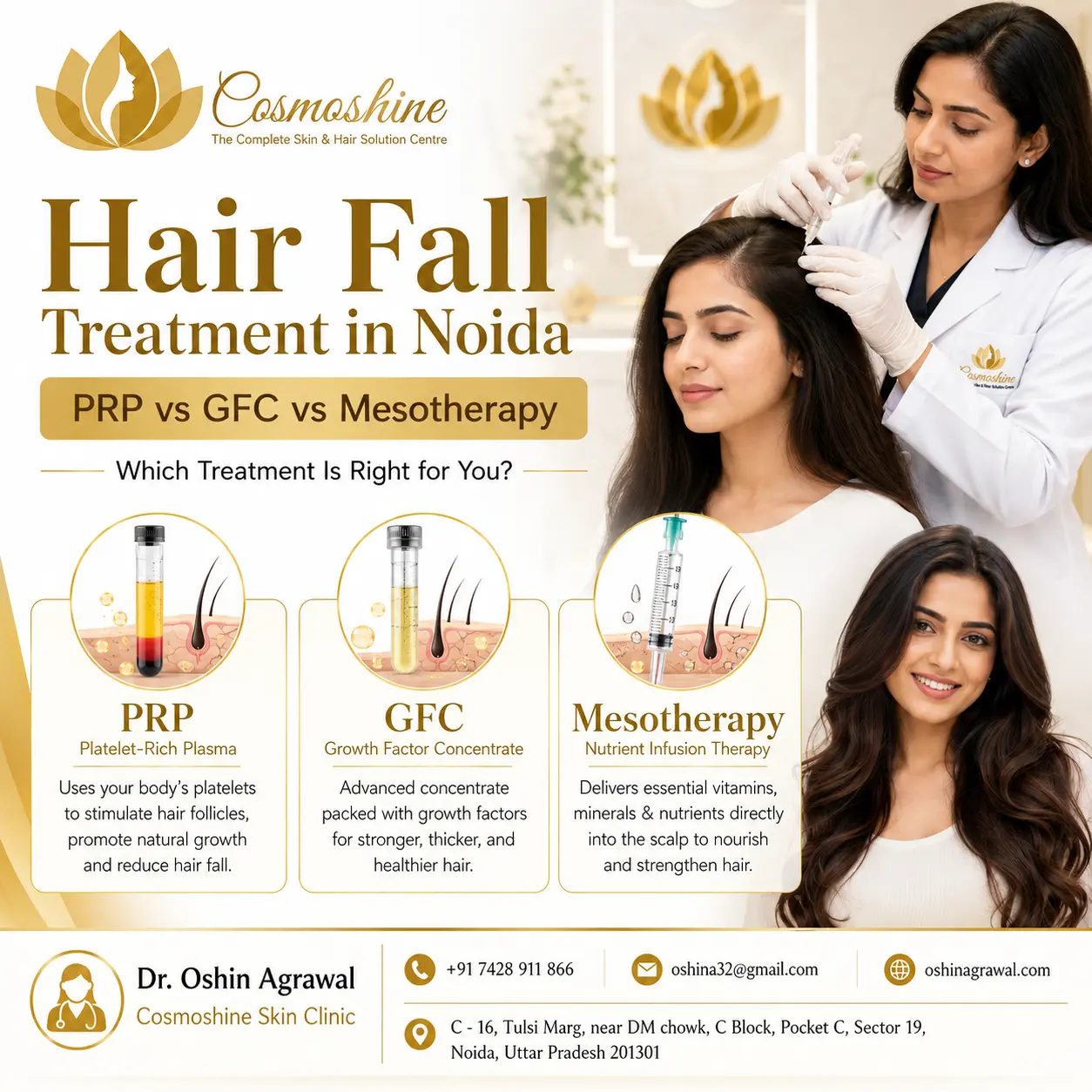
Modern dermatology offers several non-surgical options for improving hair growth, with PRP, GFC and mesotherapy among the most commonly discussed treatments. Although these procedures may sound similar because they involve treating the scalp through tiny injections, they are not exactly the same.
PRP uses platelet-rich plasma prepared from your own blood. GFC focuses on extracting and delivering concentrated growth factors from your blood. Mesotherapy uses small injections to deliver selected therapeutic ingredients directly into the scalp.
So, which one should you choose?
The answer depends on why you are losing hair, how advanced the thinning is, your scalp condition, medical history and how your hair follicles respond to treatment. Before selecting any hair growth treatment in Noida, getting the cause of hair loss correctly diagnosed is the first and most important step.
Hair shedding does not always mean permanent hair loss. Losing some hair every day is part of the normal hair-growth cycle. The concern begins when shedding becomes excessive, continues for several weeks or is accompanied by visible thinning.
Common causes of hair loss include:
This is why starting PRP, GFC or mesotherapy simply because someone else achieved good results may not be the best approach.
An experienced dermatologist for hair fall in Noida can examine the pattern of hair loss, scalp health, hair shaft quality and follicle condition before recommending treatment. In some cases, blood investigations or other diagnostic tests may also be advised.
One of the biggest mistakes people make is treating every form of hair loss in the same way.
For example, androgenetic alopecia, commonly called pattern hair loss, behaves differently from temporary stress-related shedding. Likewise, hair loss caused by an iron deficiency may require a different approach from progressive genetic thinning.
A dermatologist may evaluate:
This evaluation helps determine whether procedural treatment is needed and whether it should be combined with medicines, topical therapy, nutritional correction or changes in scalp care.
Procedures should support a diagnosis-based treatment plan rather than replace it.
PRP hair treatment in Noida is one of the better-known regenerative procedures used for certain types of hair thinning, particularly pattern hair loss.
PRP stands for platelet-rich plasma.
During treatment, a small quantity of your blood is collected and processed in a centrifuge. This separates different blood components so that platelet-rich plasma can be prepared. The resulting plasma is then injected into selected areas of the scalp.
Platelets contain biological factors involved in tissue repair and cell signalling. The aim of PRP treatment is to create a supportive environment around active or weakened hair follicles and potentially improve hair density and thickness.
The American Academy of Dermatology notes that PRP may help reduce hair loss and that some patients experience thickening or regrowth, although repeat and maintenance sessions may be required.
PRP may be considered for people with:
PRP generally works better when viable follicles are still present. Completely bald areas where follicles are no longer functioning are less likely to respond significantly to regenerative injections.
Potential advantages include:
PRP has been studied considerably more than many newer injectable hair procedures, but results still differ from person to person. No hair treatment can guarantee identical regrowth for every patient.
You can internally link GFC/PRP Therapy here for patients who want detailed information about the procedure.
GFC hair treatment in Noida stands for Growth Factor Concentrate therapy. It is also prepared using the patient’s own blood, but the processing technique is designed to obtain a preparation concentrated in platelet-derived growth factors.
These concentrated factors are injected into areas of thinning hair.
Because PRP and GFC both originate from the patient’s blood, they are often discussed together. However, their preparation techniques and final injected preparations differ.
Growth factors are signalling proteins associated with tissue repair and cellular activity. In hair treatment, the goal is to introduce these concentrated factors around weakened follicles and support conditions that may favour healthier hair growth.
Research on GFC has shown encouraging results, but its evidence base is still developing. A 2026 systematic review found improvement with autologous growth-factor injections but also highlighted substantial variation between studies, non-standardised protocols and limitations in the quality of existing evidence.
Therefore, GFC should not automatically be described as universally superior to PRP.
Depending on the individual, potential benefits may include:
A dermatologist may consider GFC particularly when a regenerative procedure is appropriate and the patient’s scalp and pattern of hair loss make them a suitable candidate.
This is one of the most common questions asked by patients looking for hair fall treatment in Noida.
PRP has been used for hair loss for longer and has a broader published evidence base. GFC is a newer refinement of autologous growth-factor treatment and aims to deliver a more concentrated growth-factor preparation.
However, that does not mean GFC will always produce better results.
Recent research comparing these treatments continues to evolve. Some studies have reported benefits with both approaches, while differences in preparation methods, treatment protocols and patient characteristics make universal comparisons difficult.
The practical decision should therefore be based on diagnosis, degree of hair loss, treatment history, dermatologist assessment and individual goals rather than choosing whichever treatment sounds more advanced.
Mesotherapy for hair loss takes a somewhat different approach.
Instead of processing the patient’s blood, mesotherapy involves delivering small quantities of selected substances directly into the scalp through multiple superficial injections.
The exact solution used can vary. Depending on the dermatologist’s assessment and protocol, mesotherapy formulations may involve medications or other bioactive ingredients intended for scalp and hair management.
This variability is important because “mesotherapy” describes a delivery technique rather than one universal formula.
By placing therapeutic substances directly into the treatment area, mesotherapy aims to provide targeted delivery around the scalp and hair follicles.
Potential benefits may include:
Research reviews have reported encouraging results, but they have also highlighted considerable variation in the products, injection techniques and treatment schedules used. More standardised research is still needed before mesotherapy can be considered a universal routine treatment for all forms of hair loss.
Patients wanting more information can be directed through an internal link to the Mesotherapy treatment page.
The major difference lies in what is being injected.
PRP uses platelet-rich plasma obtained from the patient’s own blood, whereas mesotherapy delivers selected therapeutic substances directly into the scalp.
PRP is commonly considered when regenerative stimulation is appropriate for active but weakening follicles. Mesotherapy may be chosen when targeted intradermal delivery fits the dermatologist’s treatment strategy.
Neither treatment should be selected solely according to online before-and-after photographs.
Your diagnosis matters more than the name of the procedure.
GFC and mesotherapy also work through different approaches.
GFC uses concentrated growth factors derived from the patient’s blood. Mesotherapy involves injecting selected therapeutic ingredients into targeted areas of the scalp.
For a person with progressive pattern thinning and viable follicles, a dermatologist may consider regenerative treatment such as GFC. For another patient, a mesotherapy-based approach or a combination with established medical therapy may be more appropriate.
Sometimes the best hair growth treatment in Noida is not one single procedure but a carefully planned combination.
There is no single winner for every patient.
The most important question is therefore not “Which treatment is strongest?” but “Which treatment matches the cause and stage of my hair loss?”
Hair growth is slow, so procedural treatments should not be judged after a few days.
PRP protocols commonly involve a series of initial sessions followed by maintenance in suitable patients. The exact number and interval can vary according to the patient’s diagnosis and response.
GFC is also generally performed as a series rather than a single treatment.
Mesotherapy schedules vary more because protocols and injected formulations differ.
Your dermatologist may monitor progress through:
Avoid comparing your progress with another patient’s timeline. Age, genetics, severity of thinning, medical conditions and follicle health can all influence treatment response.
Hair follicles work through growth cycles, which means meaningful improvement takes time.
Some patients first notice reduced shedding. Improvement in thickness or density may appear later as healthier hairs move through their natural growth cycle.
Visible improvement usually develops gradually over several months rather than immediately.
If a clinic promises dramatic permanent regrowth after one session, it is sensible to ask how that claim is being measured.
Hair loss treatment is not simply a cosmetic procedure.
Hair shedding can sometimes be linked to hormonal, nutritional, inflammatory or medical conditions. Consulting a qualified dermatologist for hair fall in Noida helps ensure that the underlying cause is considered before injections are started.
A dermatologist can decide whether you need:
The treatment that gives the best outcome is usually the one matched correctly to the diagnosis.
Procedures alone may not be enough.
For better long-term management:
Consistency is often more valuable than repeatedly switching from one trending treatment to another.
PRP, GFC and mesotherapy all have a role in modern hair-loss management, but they should not be treated as interchangeable procedures.
PRP has a comparatively broader body of clinical research and may be useful for appropriately selected patients with pattern hair loss. GFC offers a concentrated growth-factor approach and has emerging supportive evidence, although research protocols are still developing. Mesotherapy provides targeted intradermal delivery, but its effectiveness depends significantly on the substance being used and the patient’s diagnosis.
The right hair fall treatment in Noida therefore begins with understanding why your hair is thinning.
Instead of choosing a procedure because it is popular on social media or because someone you know received it, have your scalp and hair loss evaluated by a dermatologist. Once the cause, stage and condition of your follicles are clear, PRP, GFC, mesotherapy or a combination treatment can be selected more logically.
The goal should not simply be to undergo the newest procedure. The goal should be to protect existing follicles, control ongoing hair loss and create the best possible conditions for healthier hair growth.
Both can be useful in appropriately selected patients. PRP currently has a broader evidence base, while GFC is a newer concentrated growth-factor approach with encouraging but still developing research. Your dermatologist can recommend an option based on your type and stage of hair loss.
Not necessarily. They use different treatment approaches. PRP uses platelet-rich plasma from your own blood, while mesotherapy delivers selected substances directly into the scalp. The better choice depends on the cause of hair loss and treatment objective.
These procedures should not be considered guaranteed permanent cures. Genetic pattern hair loss is generally a progressive condition, and ongoing medical or maintenance treatment may be required.
Results are generally more favourable when active or miniaturised follicles are still present. Areas with long-standing complete baldness may respond poorly to regenerative injections. A dermatologist should examine the scalp before recommending treatment.
Look for a qualified dermatologist who diagnoses the cause of hair loss before recommending procedures, explains realistic expectations, discusses available alternatives and creates an individual treatment plan rather than offering the same procedure to every patient.
Yes. Depending on the diagnosis, dermatologists may combine procedures with topical medicines, prescription treatment, scalp therapy or correction of nutritional deficiencies. Combination treatment should be planned according to individual medical requirements.


Comments are closed