- C - 16, Tulsi Marg, C Block, Sector 19, Noida, U.P 201301
- +91 7428 911 866
- oshina32@gmail.com
FOLLOW US:
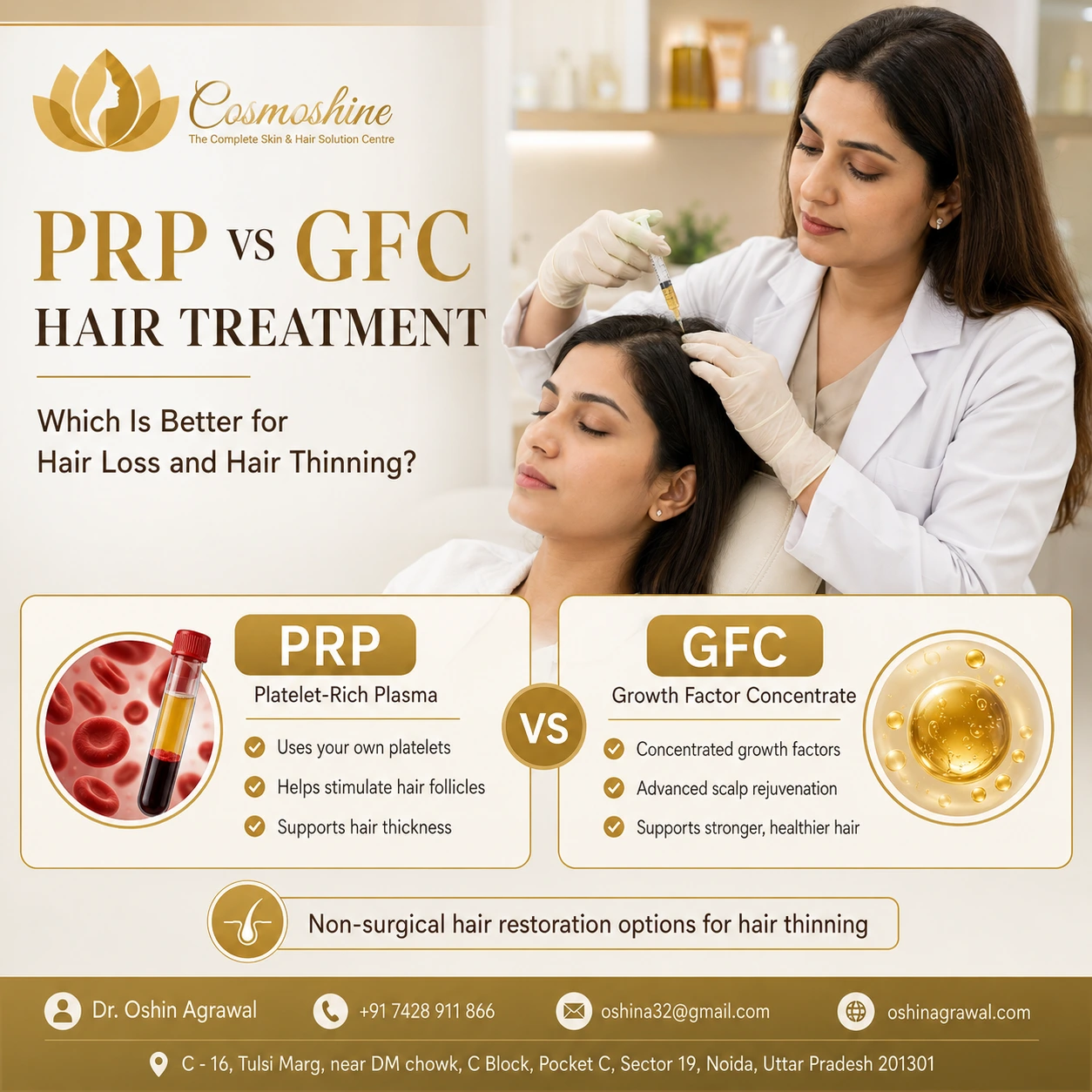
PRP vs GFC hair treatment is one of the most common comparisons for people dealing with hair loss, reduced hair density and progressive hair thinning. Both are non-surgical treatments that use components derived from your own blood, but they differ in preparation, concentration and how they are used to support weakened hair follicles.
Before comparing results, it is important to understand how each treatment works.
PRP is prepared by collecting a small amount of the patient’s blood and processing it in a centrifuge. The aim is to separate platelet-rich plasma from other blood components. This platelet-rich portion is then injected into targeted thinning areas of the scalp.
Platelets release biological growth factors involved in tissue repair and cell signalling. When PRP is used for hair loss, the objective is to provide a supportive environment around weakened but still active hair follicles.
GFC also starts with the patient’s blood. However, the processing system is designed to isolate and concentrate growth factors released from platelets. The resulting growth-factor preparation is then injected into the areas affected by thinning.
In simple terms, PRP delivers platelet-rich plasma from which growth factors are subsequently released, while GFC treatment aims to provide a concentrated preparation of those growth factors.
PRP hair treatment is a regenerative procedure that has been studied for different forms of hair loss, particularly androgenetic alopecia, which is commonly known as male or female pattern hair loss.
During a PRP session, blood is taken from the patient and processed through centrifugation. The platelet-rich plasma obtained from this process is injected into selected parts of the scalp using fine needles.
The American Academy of Dermatology notes that studies indicate PRP can be a safe and effective option for certain types of hair loss, although results take time and treatment may require repeat sessions.
A large 2025 systematic review and meta-analysis involving 43 randomized controlled trials and 1,877 participants also found that PRP could improve hair density and reduce hair loss, although outcomes varied depending on the treatment protocol.
Hair follicles receive signals from various biological factors that influence their growth cycle. Platelets contain substances associated with tissue healing, blood-vessel formation and cellular communication.
By injecting platelet-rich plasma into selected scalp areas, the treatment aims to support existing follicles and potentially improve their activity.
PRP is generally more relevant for weakened or miniaturising follicles than for areas where hair follicles have already been permanently lost.
GFC treatment for hair loss stands for Growth Factor Concentrate therapy. Like PRP, it is an autologous procedure, meaning the treatment material is prepared from the patient’s own blood.
The difference is primarily in processing.
Instead of injecting platelet-rich plasma itself, GFC preparation aims to obtain a concentrated solution containing growth factors released from platelets. This concentrate is injected into areas affected by hair thinning.
Growth factors involved in these treatments may influence cellular activity around the follicle and help create conditions that support the hair-growth cycle.
One reason GFC hair treatment in Noida and other cities has gained attention is the concentrated growth-factor approach.
In conventional PRP, the preparation contains platelets that subsequently release growth factors. In GFC, the preparation process aims to extract these growth factors before injection.
This difference does not automatically mean that GFC will produce better results for every patient. The effectiveness of either procedure depends on the diagnosis, quality of preparation, treatment technique, severity of hair loss and individual biological response.
When choosing a hair thinning treatment, patients often focus entirely on which procedure produces faster regrowth. However, the condition of the follicles is more important than the name of the treatment.
A person who has recently started noticing reduced density may respond differently from someone who has had advanced baldness for many years.
PRP and GFC are generally considered when hair follicles are still present but have become progressively weaker or miniaturised.
They may be considered in cases such as early or moderate pattern hair loss, gradual loss of density, widening of the central parting, progressive thinning around the crown or visible reduction in hair thickness.
Neither treatment should be considered a guaranteed method of restoring hair in long-standing completely bald areas.
The question of PRP vs GFC results is important because marketing claims can sometimes make one treatment appear dramatically superior to the other.
PRP currently has a considerably larger body of published research.
A recent systematic review and meta-analysis of PRP studies found evidence supporting improvements in hair density and reductions in hair loss. However, treatment protocols differed considerably between studies, which means results cannot be predicted with certainty for an individual patient.
Research specifically comparing PRP with GFC is more limited.
A recent retrospective study involving 42 patients with male or female pattern hair loss compared three sessions of PRP and GFC given four weeks apart. The researchers reported greater improvements in total hair count, hair-shaft diameter and overall aesthetic improvement scores in the GFC group. However, because the study was relatively small and retrospective, it should not be interpreted as proof that GFC is universally superior to PRP.
This distinction is important.
Early comparative studies make GFC promising, but PRP currently has a broader clinical evidence base. More large, well-designed and standardized comparative trials are needed before claiming that one treatment is definitively better.
Neither PRP nor GFC produces immediate hair growth.
Hair follows a biological growth cycle, so meaningful changes usually require time. Patients may first notice reduced shedding before they notice improvements in thickness or density.
The timing also depends on the stage of hair loss, age, genetics, medical conditions, scalp health, concurrent treatment and how well the follicles respond.
A treatment should therefore not be judged a few days after the first session.
Standardised scalp photographs or trichoscopic assessment can provide a more reliable comparison than checking the mirror every day.
There is no single session schedule suitable for everyone.
PRP is commonly performed as an initial series of treatment sessions followed by maintenance when clinically appropriate.
GFC is also usually performed over multiple sessions rather than being treated as a one-time procedure.
The precise interval and number of sessions should be decided after evaluating the patient’s pattern and severity of hair loss.
More treatment sessions do not necessarily mean better results. A dermatologist should monitor the response and decide whether continuing, modifying or combining treatment is appropriate.
Both PRP and GFC can be considered forms of non surgical hair loss treatment because they do not involve transplantation or surgical removal and placement of hair follicles.
This makes them attractive to patients who are experiencing early or moderate thinning and want to explore treatment before considering surgery.
However, “non-surgical” does not mean that every person with hair loss should undergo PRP or GFC.
Hair loss may occur because of thyroid disorders, nutritional deficiencies, severe stress, hormonal changes, recent illness, certain medicines, autoimmune conditions or inflammatory scalp disorders.
Treating the scalp without identifying the underlying cause may lead to disappointing results.
GFC may be considered for people experiencing progressive pattern thinning while viable follicles are still present.
A dermatologist may consider factors such as the pattern of thinning, follicle miniaturisation, age, medical history, previous treatments and realistic expectations before recommending GFC.
Patients searching for GFC hair treatment in Noida should therefore look beyond the cost or number of sessions advertised by a clinic.
The first question should be whether GFC is medically suitable for their specific type of hair loss.
PRP may also be considered for appropriately selected patients with pattern hair loss.
Because PRP has been studied more extensively, dermatologists have a larger body of research available when evaluating its use for androgenetic alopecia.
Research suggests that PRP can help improve hair density in some patients with androgenetic alopecia, although treatment response varies and protocols are not completely standardized.
PRP may be more appropriate when follicles are weakened but remain active and when the dermatologist believes regenerative treatment can complement the overall hair-loss management plan.
There is no scientifically responsible answer that says PRP is always better or GFC is always better.
If you look purely at the amount of existing research, PRP currently has the stronger evidence base.
If you look at some recent direct comparative research, GFC has shown promising results and may produce stronger improvements in certain measurements in some patient groups. However, the amount of GFC-specific comparative research remains significantly smaller.
Therefore, choosing treatment should not be based solely on phrases such as “advanced PRP,” “latest GFC” or “guaranteed regrowth.”
The most appropriate treatment depends on the patient’s diagnosis.
For one person, PRP may be appropriate. Another may be better suited to GFC. Someone else may need medical treatment rather than injections, while another patient may benefit from a combination approach.
Before deciding between PRP and GFC, determine why the hair is falling.
A dermatologist may examine the scalp, pattern of hair loss, hair-shaft diameter and degree of follicular miniaturisation. Depending on the history, additional investigations may be recommended.
For example, sudden diffuse shedding after severe illness behaves differently from hereditary pattern thinning. Patchy autoimmune hair loss is also different from androgenetic alopecia.
This is why two patients who appear to have similar hair fall can require completely different treatment plans.
Yes. Hair-loss management often works best as a combination strategy rather than relying on one procedure alone.
Depending on the diagnosis, a dermatologist may combine procedural treatment with topical therapy, prescription medication, treatment for dandruff or scalp inflammation, correction of documented nutritional deficiencies or lifestyle changes.
The important point is that combination therapy should be medically planned.
Using multiple procedures without knowing the cause of hair loss does not automatically increase the chance of success.
Whatever treatment is selected, several factors can influence the final outcome:
Hair regrowth is a gradual biological process. Consistency usually matters more than frequently switching between trending treatments.
If you are considering GFC hair treatment in Noida, PRP or another hair-restoration procedure, a dermatologist consultation should come before choosing the procedure.
The purpose of consultation is not simply to decide between PRP and GFC. It is to determine whether you need an injectable procedure at all.
A dermatologist can differentiate pattern hair loss from temporary shedding, autoimmune conditions and scalp disorders and can then create a personalised plan based on the diagnosis.
This can prevent unnecessary procedures and help set realistic expectations about hair density, thickness, maintenance and the time needed to see visible improvement.
The PRP vs GFC hair treatment decision cannot be reduced to a simple winner.
PRP is an established regenerative option with a comparatively larger body of clinical research supporting its use in certain forms of hair loss. GFC is a newer approach designed to deliver concentrated platelet-derived growth factors and has shown encouraging results in emerging comparative studies.
For early or moderate hair thinning with viable follicles, both may have a role as a non surgical hair loss treatment.
However, PRP may remain attractive because of its larger evidence base, while GFC may be considered when a concentrated growth-factor approach is appropriate for the individual patient.
The best choice ultimately depends on the cause and stage of hair loss rather than which procedure is newer.
If you are experiencing persistent hair fall, widening of the parting, reduced density or progressive thinning, getting your scalp examined early can make treatment planning more effective. Once the cause has been identified, your dermatologist can determine whether PRP, GFC, medical therapy or a combination approach is most suitable.
GFC has shown promising results in some recent comparative studies, but there is currently less published research on GFC than on PRP. It cannot yet be said that GFC is universally better for every patient.
Results vary according to the type and stage of hair loss, follicle health, preparation method and individual response. Some recent studies favour GFC on certain measurements, while PRP has a considerably broader evidence base.
PRP may help some appropriately selected patients with pattern hair loss, particularly while active but miniaturising follicles are still present. A dermatologist should first confirm the cause of the thinning.
GFC should not be considered a guaranteed permanent cure. Pattern hair loss can be progressive, so maintenance treatment or additional medical therapy may still be required.
These treatments are generally more useful when functioning or miniaturised follicles remain. Long-standing completely bald areas where follicles have been permanently lost are unlikely to respond in the same way.
Hair growth occurs gradually. Changes in shedding may be noticed before improvements in density or thickness. Meaningful assessment usually requires several months and should ideally be based on standardized photographs or clinical evaluation.





Comments are closed