- C - 16, Tulsi Marg, C Block, Sector 19, Noida, U.P 201301
- +91 7428 911 866
- oshina32@gmail.com
FOLLOW US:
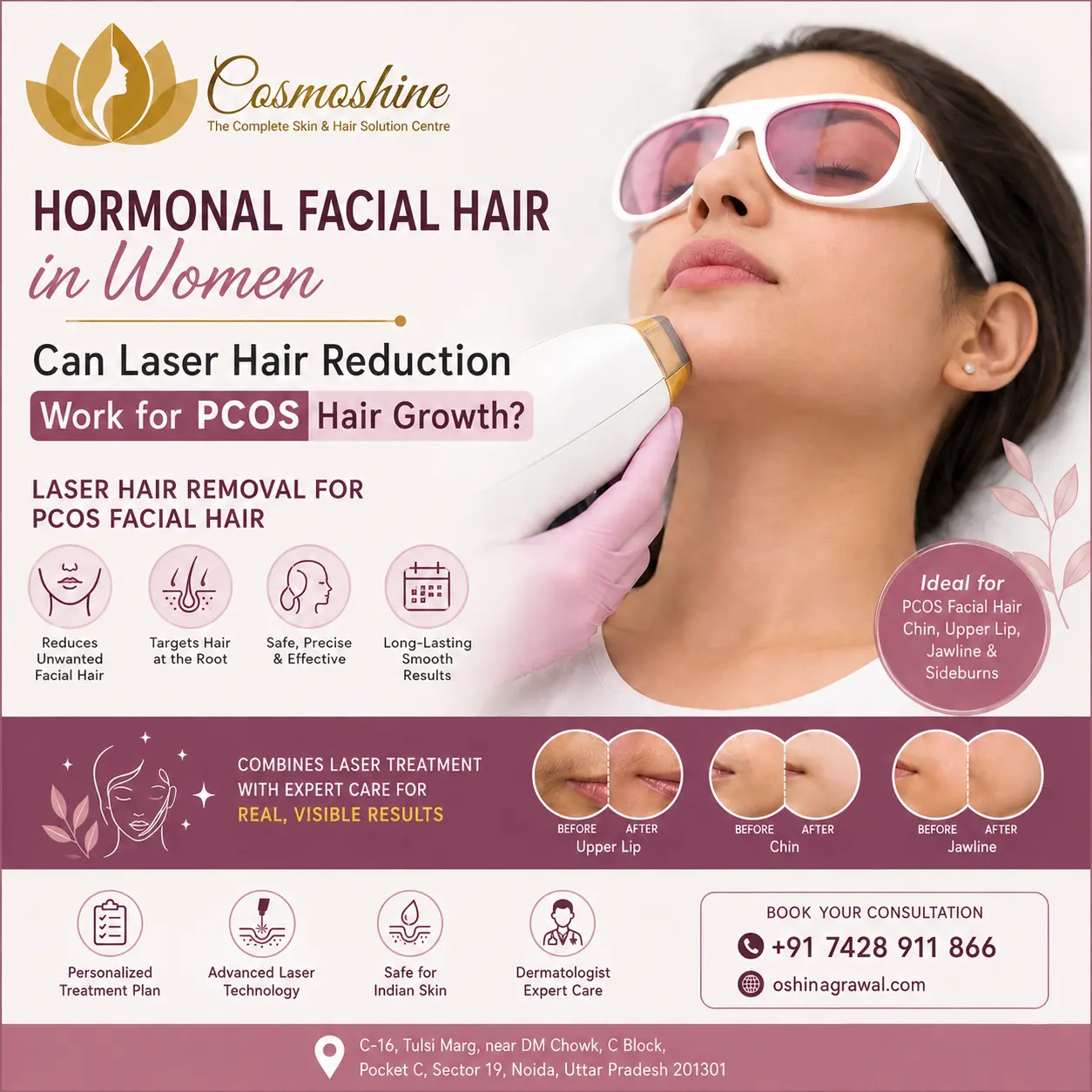
Laser hair removal for PCOS facial hair can be an effective way to reduce unwanted coarse hair on the chin, upper lip, jawline and sideburn area. However, because PCOS-related facial hair is influenced by hormones, treatment usually requires a different approach than laser hair reduction for ordinary unwanted hair.
Women with PCOS may notice darker or thicker facial hair even when they follow a regular skincare routine. Some experience only a few coarse chin hairs, while others develop noticeable growth around the upper lip, cheeks, neck and jawline.
Repeated threading, waxing, shaving and plucking can become frustrating and may also contribute to irritation, ingrown hairs and pigmentation.
At Cosmoshine Skin & Hair Solution Centre in Noida, women with hormonal facial hair can be evaluated before starting laser treatment so that the procedure is planned according to their skin tone, hair thickness and pattern of growth.
The important thing to understand is that laser can significantly reduce unwanted hair, but it does not cure PCOS itself. Managing the hormonal cause along with laser treatment often provides a more practical long-term approach.
Polycystic Ovary Syndrome, commonly known as PCOS, is a hormonal condition that can affect menstrual cycles, metabolism, skin and hair growth.
Some women with PCOS have higher levels of androgens, commonly referred to as male-type hormones. Women naturally have androgens too, but when levels are higher or hair follicles are particularly sensitive to them, coarse dark hair may begin growing in areas where women usually have finer hair.
This type of excessive terminal hair growth is known as hirsutism.
Common areas affected include:
Facial hair associated with PCOS can continue developing because hormonal signals continue stimulating susceptible follicles.
This is why a proper PCOS facial hair treatment plan often needs to address both the visible hair and its underlying hormonal influence.
Yes. Laser hair removal for PCOS facial hair can reduce unwanted coarse and pigmented facial hairs when the patient is a suitable candidate.
Laser hair reduction works by directing controlled light energy toward pigment present in the hair follicle. The energy is converted into heat, which damages the follicle and reduces its ability to produce the same type of hair.
However, only follicles in the active growth phase respond optimally during a particular session. Because not every facial hair is in the same phase at the same time, multiple sessions are required.
With PCOS, another factor must be considered.
Even after existing follicles respond well to laser, hormonal stimulation can activate other susceptible follicles in the future. Therefore, women with PCOS may require more sessions or occasional maintenance compared with women whose unwanted facial hair is not hormonally driven.
Laser should therefore be viewed as long-term hair reduction, rather than a guaranteed permanent removal of every hair.
When facial hair is caused by PCOS, simply removing visible hair does not address why that hair developed.
A good PCOS facial hair treatment plan may involve two components:
Depending on the patient’s symptoms, a dermatologist may recommend consulting a gynaecologist or another appropriate medical specialist for PCOS management.
This is particularly important if facial hair occurs along with symptoms such as:
At Cosmoshine Skin & Hair Solution Centre, treatment planning focuses on the individual pattern of hair growth rather than using the same laser protocol for every patient.
During laser treatment for facial hair, a specialised laser device emits energy that is absorbed by melanin in dark hair.
The heat generated affects the follicle responsible for producing the hair while appropriate settings are chosen to protect the surrounding skin.
Over repeated sessions, patients generally notice that treated hairs become:
The objective is progressive reduction.
Facial hair cannot generally be cleared completely in a single session because hair grows in cycles.
The chin is one of the most common areas where women with PCOS notice coarse facial hair.
Some women initially see only one or two dark chin hairs and repeatedly pluck them. Over time, more follicles may become noticeable, particularly when hormonal stimulation continues.
For frequent chin hair removal for women, laser reduction can be more convenient than repeatedly waxing, threading or plucking.
Chin hair tends to be relatively coarse and dark in many women with PCOS, which can make it a suitable laser target when there is sufficient contrast between the hair pigment and skin.
However, assessment remains important because very fine hair responds differently from coarse terminal hair.
This is where expectations need to be realistic.
A hormonal facial hair treatment using laser can effectively target follicles that currently produce suitable pigmented hairs. What it cannot do is permanently switch off the hormonal process associated with PCOS.
If androgen activity continues stimulating previously fine or inactive follicles, new coarse hair may appear later.
That does not mean the laser has failed.
It means the underlying hormonal condition is still influencing hair growth.
For this reason, women with PCOS may benefit most when medical management and cosmetic hair reduction are approached together.
There is no fixed number of sessions that guarantees the same result for every woman.
The number of sessions required for laser hair reduction for women depends on:
Facial areas are particularly influenced by hormones, so PCOS patients may need a longer treatment course and maintenance sessions.
Sessions are normally spaced according to the facial hair-growth cycle.
Your dermatologist should assess progress after each stage rather than promising an exact number of sessions before examining your hair pattern.
Improvement is progressive.
After a treatment session, treated hairs do not necessarily disappear immediately. Some gradually shed over the following days or weeks.
As treatment progresses, you may notice:
Because PCOS is hormonally driven, results may develop differently from those in women without a hormonal condition.
It is important to complete the recommended course instead of judging the treatment after one or two sessions.
Laser treatment is more accurately described as long-term hair reduction rather than permanent elimination of every hair follicle.
Some follicles may respond strongly and stop producing noticeable coarse hair for a long time.
Others may produce finer regrowth.
With PCOS, hormones can also stimulate new follicles, meaning maintenance treatment may occasionally be required.
Therefore, advertisements promising “100% permanent PCOS facial hair removal” should be approached cautiously.
A realistic goal is substantial, long-lasting reduction in unwanted facial hair and easier ongoing management.
Women considering female facial hair removal in Noida should ideally undergo a consultation before treatment.
Laser typically works best on pigmented hair because the technology targets melanin.
Coarse black or dark-brown hairs often respond better than extremely fine, white, grey or very light hairs.
A dermatologist should evaluate:
These factors help determine whether laser is suitable and what treatment parameters should be used.
Indian skin tones require careful selection of laser technology and treatment parameters.
Using inappropriate settings may increase the risk of unwanted reactions, especially in patients prone to pigmentation.
A dermatologist-led clinic can customise settings according to skin tone, hair thickness and treatment area.
At Cosmoshine Skin & Hair Solution Centre, laser treatment is planned after evaluating the patient’s skin and hair characteristics rather than applying one standard setting to every person.
This personalised approach is particularly valuable for sensitive facial areas.
Waxing, threading from the roots and plucking can interfere with the laser process because they remove the hair from the follicle.
Laser requires pigment within the follicle to target the hair effectively.
Patients are commonly advised to shave or trim when necessary between treatments rather than pull hairs from the roots.
However, follow the specific pre- and post-treatment instructions provided by your dermatologist because recommendations can vary according to your skin and treatment protocol.
Most patients describe the sensation as brief heat, snapping or mild prickling.
The level of discomfort depends on:
Areas such as the upper lip may feel more sensitive because they contain many nerve endings.
Modern cooling techniques can improve comfort during treatment.
PCOS itself does not automatically prevent someone from undergoing laser hair reduction.
Safety depends more on proper patient selection, skin type, treatment settings and professional supervision.
Possible temporary reactions can include:
These generally settle after treatment.
Improperly selected settings can increase the risk of burns or pigmentation, which is why facial laser procedures should be performed carefully.
Regrowth can happen for several reasons.
In women with PCOS, ongoing hormonal stimulation is a major factor.
Other reasons may include incomplete treatment sessions, very fine hair, changes in hormones, inappropriate laser parameters or stopping treatment too early.
There is also an important distinction between regrowth of treated hair and development of newly stimulated hair follicles.
A dermatologist can help determine what is happening if hair becomes noticeable again after treatment.
Managing PCOS can be important for controlling future hormonal hair growth.
A woman may achieve good laser reduction but continue developing new facial hairs if androgen-driven stimulation remains uncontrolled.
Depending on the individual case, PCOS management may involve evaluation of:
Laser treats the unwanted facial hair itself. Medical PCOS management addresses the underlying health condition.
Using both approaches where appropriate can provide a more comprehensive strategy.
Waxing and threading remove hair temporarily. Once the follicle begins producing another hair, visible regrowth returns.
Laser works differently because it targets the follicle itself.
For women who repeatedly remove chin or upper-lip hair every few days, laser can reduce the frequency of hair removal over time.
It may also help reduce some problems associated with frequent plucking or waxing, such as:
However, laser should be performed appropriately, especially on facial skin.
Women seeking professional treatment for unwanted hormonal facial hair can consult Dr. Oshin Agrawal at Cosmoshine Skin & Hair Solution Centre, Noida.
Rather than viewing every facial-hair concern as the same problem, treatment begins with understanding the patient’s hair pattern, skin type and possible hormonal factors.
Cosmoshine offers dermatologist-supervised skin, hair and laser care with treatment plans tailored according to individual needs.
For women with PCOS, this is particularly important because the treatment goal is not simply to remove visible hair. It is to create a realistic strategy for reducing existing coarse hair while understanding the possibility of hormonally stimulated future growth.
Yes, laser hair removal for PCOS facial hair can be an effective option for reducing coarse, dark and unwanted facial hair.
It can significantly decrease hair density, slow regrowth and make facial hair easier to manage. However, PCOS is a hormonal condition, and laser does not cure the underlying hormonal imbalance.
This means some women may require more treatment sessions or occasional maintenance compared with people who do not have hormonally driven facial hair.
The best results come from realistic expectations, appropriate laser technology, correct treatment settings and management of underlying PCOS when necessary.
If persistent chin hair, upper-lip hair or jawline growth is bothering you, a dermatologist assessment can help determine whether laser treatment for facial hair is suitable for you.
At Cosmoshine Skin & Hair Solution Centre in Noida, Dr. Oshin Agrawal provides personalised consultation and laser hair-reduction planning based on each patient’s skin, hair and individual concerns.
Yes. Laser can significantly reduce dark and coarse facial hair associated with PCOS. Because hormonal stimulation can continue, some patients may need additional or maintenance sessions.
Laser can provide long-term reduction, but complete permanent removal cannot be guaranteed. PCOS can stimulate new facial hairs over time, so maintenance may be necessary.
The number varies depending on hair thickness, skin tone, hormonal activity and treatment response. Women with PCOS may require more sessions than patients with non-hormonal unwanted hair.
Threading temporarily removes visible hair, whereas laser targets the hair follicle to achieve progressive reduction. For repeated coarse hair growth, laser may offer longer-lasting management.
Appropriate patient selection and laser parameters are important. Very fine facial hair can behave differently from coarse hair, which is why dermatologist evaluation is recommended before treatment.
Many women can undergo laser while receiving medical management for PCOS, but you should inform your dermatologist about all medicines and treatments you are taking.



Comments are closed