- C - 16, Tulsi Marg, C Block, Sector 19, Noida, U.P 201301
- +91 7428 911 866
- oshina32@gmail.com
FOLLOW US:
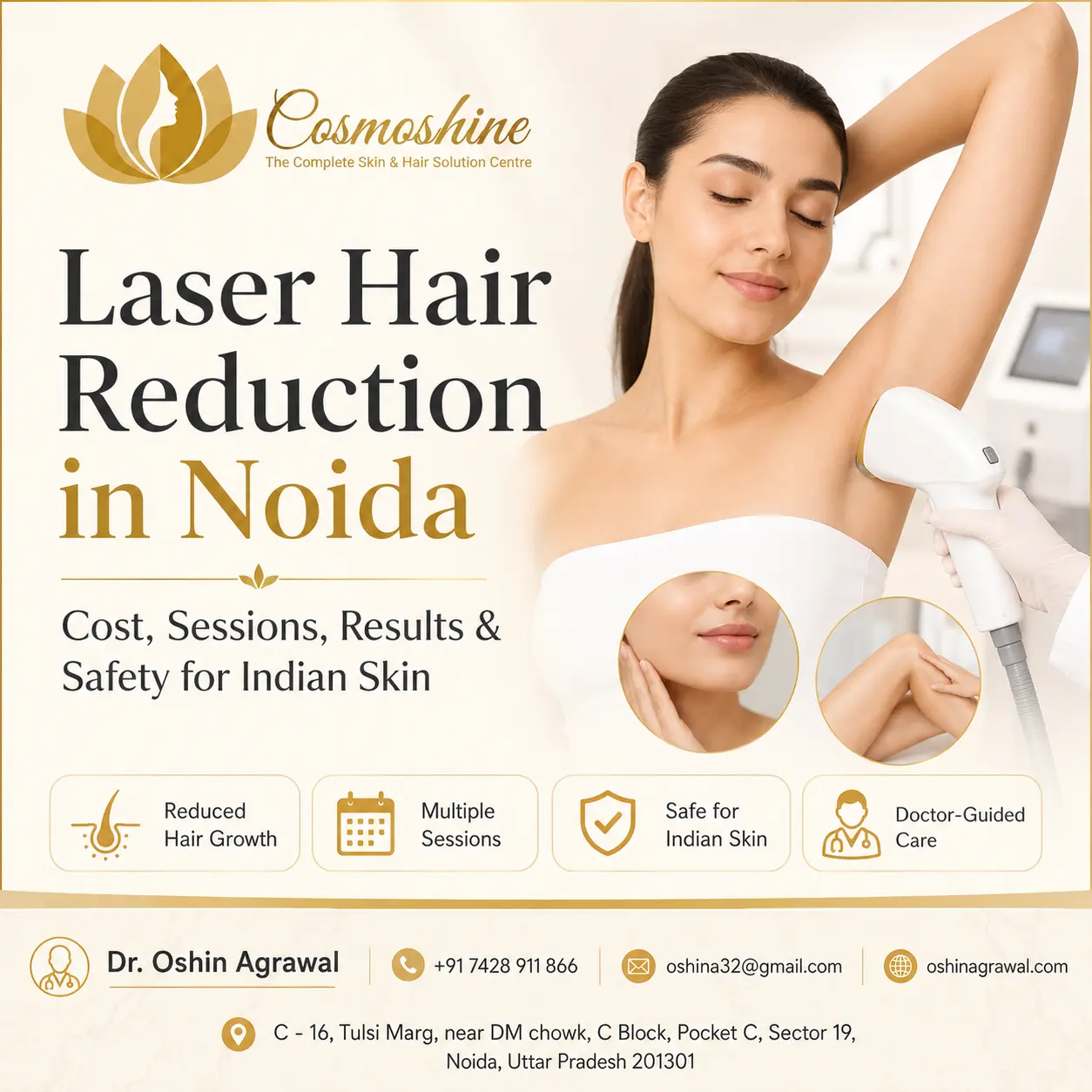
Laser hair reduction in Noida has become a popular option for people who are tired of repeatedly shaving, waxing, threading, or using hair-removal creams. These temporary methods may work for a few days or weeks, but unwanted hair eventually returns, and frequent removal can sometimes lead to irritation, razor bumps, ingrown hair, or darkening in sensitive areas.
Laser hair reduction offers a longer-term approach by targeting the hair follicle with controlled light energy. The aim is not to damage the skin but to gradually reduce the thickness, density, and regrowth of unwanted hair over a planned series of sessions.
For Indian skin, treatment planning is especially important because skin tone, hair colour, hair thickness, tanning, hormonal factors, and the type of laser technology can influence both safety and results.
If you are considering laser hair removal in Noida, understanding the procedure before booking a session can help you set realistic expectations about cost, number of sessions, maintenance, results, and safety.
At Cosmoshine Skin Clinic, patients can learn more about dermatologist-guided Laser Hair Reduction for unwanted facial and body hair.
Laser hair reduction works by directing a controlled beam of light toward the pigment present in the hair.
The light energy is absorbed by the pigment in the hair and converted into heat. This heat affects the hair follicle and reduces its ability to produce the same amount of coarse hair in the future.
However, not every hair on the body is growing at the same time.
Hair naturally moves through different growth phases. Laser treatment is most effective when the hair is in an active growth phase, which is one of the main reasons multiple sessions are necessary.
With each properly timed session, more active follicles can be targeted.
Over time, patients may notice:
The response varies from person to person, so laser treatment should be understood as a gradual process rather than an instant hair-removal procedure.
This is one of the most common questions patients ask.
Although people frequently search for terms such as permanent hair reduction Noida, the more accurate expectation is long-term hair reduction rather than guaranteeing that every single hair will disappear forever.
After a complete treatment course, many people experience a significant and long-lasting reduction in unwanted hair.
Some hair may eventually regrow, but it is often:
Maintenance sessions may sometimes be needed depending on the treatment area and individual factors.
Hormonal changes can also influence new hair growth, particularly on the female face.
Therefore, a responsible dermatologist should explain expected reduction rather than promising unrealistic “100% permanent removal.”
There is no universal number of sessions suitable for every patient.
Most people require a series of treatments because only a proportion of hair follicles are in the correct growth phase at any one time.
The recommended number of sessions can depend on:
Some areas may respond faster than others.
For example, coarse underarm or leg hair may respond differently from fine facial hair.
Treatment sessions are generally spaced apart so that new hair entering its active growth stage can be targeted at the next appointment.
Skipping sessions or scheduling them too close together may affect the overall treatment plan.
The laser hair removal cost in Noida cannot be accurately determined from a single universal price because several factors influence the final treatment cost.
Treating a small area such as the upper lip requires less time than treating full legs, back, chest, or multiple body areas.
Someone treating only underarms will usually have a different treatment plan from a person choosing multiple areas or full-body treatment.
Laser hair reduction is normally performed as a series rather than as a single treatment.
The total cost therefore depends partly on how many sessions are advised.
Dense, coarse hair may require a different treatment plan compared with sparse or finer hair.
Skin tone, tanning, hair colour, and hair thickness influence the choice of settings and treatment planning.
Cost should not be compared only on the basis of the cheapest session available.
The equipment being used, hygiene standards, consultation, skin assessment, treatment settings, and supervision can all influence both safety and results.
When comparing clinics, ask what is included in the treatment plan rather than judging only by a promotional package price.
Yes, laser hair reduction can be considered for Indian skin, but the procedure needs to be planned carefully.
Indian skin includes a wide range of skin tones, and darker skin contains more melanin.
Because laser hair removal also works by targeting pigment, the treatment must differentiate effectively between the pigment in the hair and pigment in the surrounding skin.
Incorrect settings or inappropriate treatment may increase the risk of:
This does not mean darker skin should avoid laser hair reduction.
Instead, it highlights why the patient’s skin tone, current tanning, hair characteristics, and medical history should be assessed before treatment.
A qualified dermatologist can determine whether laser treatment is suitable and which parameters should be used for a particular skin type.
A recent tan changes the amount of pigment present in the skin.
This can make it more difficult for laser energy to selectively target the hair while protecting surrounding skin.
For this reason, patients may be advised to avoid excessive sun exposure before treatment.
Sun protection is also important after treatment because the skin may temporarily become more sensitive.
A dermatologist may recommend:
These precautions are particularly important for exposed areas such as the face, arms, and legs.
Full body laser hair reduction is popular among patients who regularly remove hair from several areas and want a more convenient long-term solution.
Common treatment areas include:
Not every patient needs full-body treatment.
Some people may choose only high-maintenance areas such as the face, underarms, or bikini line, while others prefer several body areas.
Treatment time and number of sessions depend on how many areas are included.
A consultation can help decide whether individual-area sessions or a full-body plan is more practical.
Unwanted facial hair can be particularly frustrating because it is highly visible and often needs frequent threading, waxing, or shaving.
A facial hair laser treatment may be considered for areas such as:
However, female facial hair requires careful evaluation.
Hair growth on the chin or jawline can sometimes be influenced by hormonal factors.
For example, women with irregular periods, acne, sudden hair growth, weight changes, or other hormonal symptoms may need further medical evaluation.
Laser treatment can reduce existing suitable hair, but it does not necessarily treat the underlying hormonal trigger responsible for producing new hair.
This is why facial laser hair reduction may sometimes require more maintenance than treatment on areas such as the underarms or legs.
Many people with unwanted dark hair may be suitable candidates, but treatment works differently according to hair characteristics.
Laser energy relies on pigment in the hair, so darker and coarser hair usually provides a clearer target than very light hair.
A dermatologist may assess:
Very light blonde, grey, or white hair may respond poorly because there is less pigment available for the laser to target.
This is another reason why patients should undergo an assessment before purchasing a large treatment package.
Results are gradual.
You should not expect every treated hair to disappear immediately after the first appointment.
After treatment, some targeted hairs may shed over the following period, while other hairs that were not in the correct growth stage will continue to appear.
With successive sessions, many patients notice:
Results can differ between body areas.
Hormone-sensitive facial areas may behave differently from arms, legs, or underarms.
It is therefore better to evaluate progress over the full treatment course rather than judging the procedure after one or two sessions.
Most patients describe laser hair reduction as causing temporary warmth, mild stinging, or a snapping sensation.
Discomfort varies according to:
Sensitive areas may feel more uncomfortable than larger body areas.
Modern treatment systems may use cooling methods to improve comfort during the procedure.
After treatment, mild redness or warmth can occur temporarily.
Patients should immediately inform the treating professional if they experience excessive burning or unusual discomfort.
Preparation can influence both safety and effectiveness.
Your dermatologist may provide specific instructions based on the treatment area.
General preparation may include:
Waxing and plucking remove the hair from its follicle.
Since laser treatment needs the follicle and hair pigment as a target, these methods may need to be stopped before sessions.
Shaving removes hair at the skin surface without pulling the follicle out.
Your clinic will tell you when the treatment area should be shaved.
A recent tan may affect safe treatment settings.
Tell your dermatologist about prescription medicines, supplements, recent procedures, and skincare products.
This is particularly important when treating facial areas.
Proper aftercare helps the skin recover comfortably.
Immediately after treatment, some people may notice temporary redness or sensitivity.
Your dermatologist may advise you to:
Do not apply random strong acids, scrubs, or active products immediately after treatment unless your dermatologist has specifically advised them.
Skin response varies, so personalized aftercare instructions should always take priority.
Yes.
Laser hair reduction is not limited to women.
Men commonly seek treatment for areas such as:
Some men choose laser treatment because repeated shaving causes razor bumps, irritation, or ingrown hair.
Others simply want to reduce excessive hair density rather than remove every hair completely.
The desired result should be discussed before treatment so the settings and treatment plan can be matched to the patient’s goals.
Waxing and laser hair reduction serve different purposes.
Waxing physically removes existing hair and provides temporary smoothness.
Laser treatment aims to gradually reduce the follicle’s ability to produce coarse hair.
Waxing may initially seem cheaper per appointment, but it needs to be repeated indefinitely.
Laser treatment requires multiple planned sessions initially but may significantly reduce the frequency of hair removal in the long term.
The better option depends on your budget, skin sensitivity, hair type, treatment area, and preference.
When searching for the best dermatologist for laser hair removal in Noida, do not choose a clinic only because it offers the cheapest package.
Laser treatment involves medical-grade energy being delivered to the skin.
Before proceeding, consider asking:
A good consultation should answer these questions before treatment begins.
Laser hair reduction in Noida can be a practical long-term solution for people who want to reduce unwanted facial or body hair and decrease their dependence on shaving, threading, waxing, or creams.
However, successful treatment is not simply about choosing a laser machine.
Skin tone, hair characteristics, hormonal factors, treatment intervals, medical supervision, sun exposure, and aftercare all influence the final outcome.
For Indian skin in particular, choosing suitable treatment settings is important because inappropriate treatment can increase the risk of unwanted pigmentation or irritation.
Whether you are considering laser hair removal in Noida, full body laser hair reduction, or treatment only for facial hair, the first step should be an individual assessment rather than selecting a package based only on price.
Dr. Oshin Agrawal at Cosmoshine Skin Clinic, Sector 19, Noida provides dermatologist-guided consultation for patients considering Laser Hair Reduction for facial and body hair.
The number varies according to the treatment area, hair thickness, skin tone, hormonal factors, and individual response. Multiple sessions are generally required because hairs grow in different phases.
Laser treatment can provide long-term reduction in hair growth. Some hair may eventually return and may require maintenance treatment. Regrowth is often finer and less dense.
It can be suitable for Indian skin when the patient’s skin tone, tanning, hair characteristics, and other factors are properly assessed and appropriate treatment settings are used.
Cost usually depends on the treatment area, number of areas, number of sessions, hair density, technology used, and treatment plan.
Laser can significantly reduce suitable facial hair, but female facial hair may be influenced by hormones. New growth can occur, so maintenance sessions may sometimes be required.
Many facial and body areas can be treated, but suitability should be assessed individually. A dermatologist can recommend whether full-body treatment or selected areas are more appropriate.
Waxing or plucking is generally avoided during a laser treatment course because these methods remove the follicular hair that the laser needs to target. Follow your clinic’s specific instructions about shaving between sessions.
Look for a dermatologist who evaluates your skin tone and hair pattern, discusses realistic results and risks, explains treatment settings and aftercare, and creates an individualized treatment plan rather than offering the same package to every patient.



Comments are closed