- C - 16, Tulsi Marg, C Block, Sector 19, Noida, U.P 201301
- +91 7428 911 866
- oshina32@gmail.com
FOLLOW US:
Pigmentation treatment in Noida is commonly searched by people dealing with dark patches, uneven skin tone, melasma, tanning, or marks that remain long after acne has healed. Although all of these concerns may make the skin look darker in certain areas, they are not necessarily the same condition and should not always be treated in the same way.
One person may have symmetrical brown patches caused by melasma, while another may have isolated sun spots or brown marks left after pimples. The depth of pigment, trigger, skin type, sun exposure, hormones, and previous skincare can all influence the treatment approach.
That is why effective pigmentation care usually begins with identifying what type of pigmentation you actually have rather than immediately choosing a peel, laser, serum, or facial.
For Indian skin in particular, treatment needs to be thoughtful because aggressive procedures or unsuitable products may sometimes cause further irritation and post-inflammatory pigmentation.
This guide explains the difference between melasma, dark spots, and post-acne marks, along with commonly considered dermatologist-guided options such as laser toning, chemical peels, and microneedling.
Skin colour is largely influenced by a natural pigment called melanin.
Melanin itself is not a problem. It plays an important role in protecting the skin. Pigmentation concerns arise when excess pigment develops in certain areas or is distributed unevenly.
Several factors can stimulate excess pigmentation, including:
This is why skin pigmentation treatment in Noida should ideally start with identifying the trigger.
Simply using a “brightening” cream may not solve the problem if the underlying condition is melasma, ongoing acne, repeated irritation, or continued sun exposure.
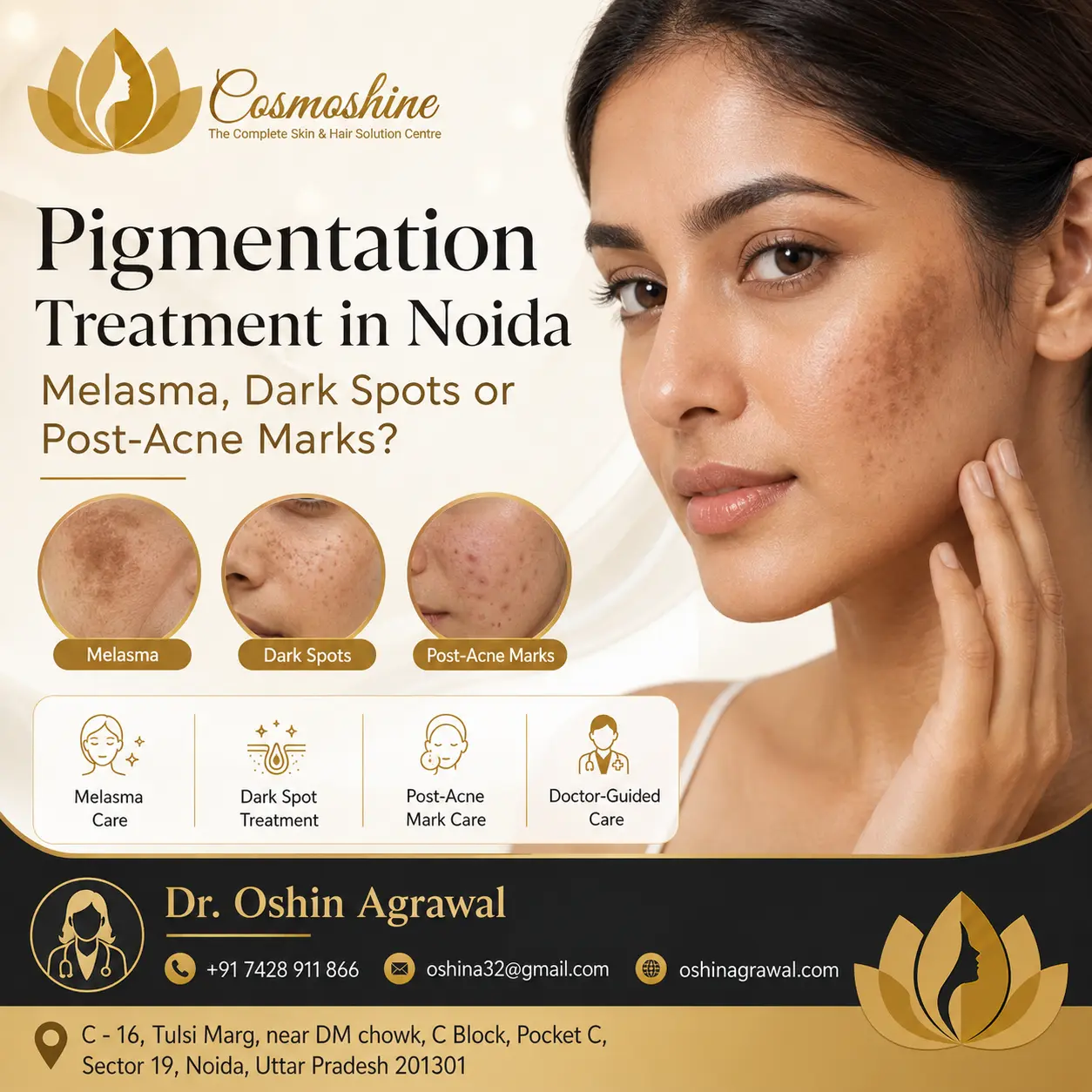
Melasma is a common pigmentation condition that usually appears as brown or grey-brown patches on the face.
It frequently affects areas such as:
The patches often appear on both sides of the face rather than as one isolated spot.
Melasma may be influenced by several factors, including sun exposure, visible light, heat, hormonal changes, pregnancy, and genetic tendency.
Women are more commonly affected, although men can also develop melasma.
Melasma is not simply a stain sitting on the surface of the skin.
Pigment may be present at different depths, and triggers such as sun exposure and hormones can continue stimulating pigment production even after improvement has started.
For this reason, melasma treatment in Noida usually requires a longer-term strategy rather than a one-time procedure.
A dermatologist may focus on:
The goal is usually to control and lighten melasma while reducing the chance of repeated flare-ups.
No.
A small isolated dark spot is not automatically melasma.
Dark spots may result from:
The appearance and location of the pigmentation provide important clues.
For example, multiple symmetrical patches across the cheeks may suggest melasma, while an isolated brown mark at the exact site of an old pimple may represent post-inflammatory hyperpigmentation.
This distinction matters because the most suitable dark spots treatment can differ according to what caused the mark.
Trying to aggressively remove every dark patch with the same treatment may sometimes irritate the skin and make pigmentation more noticeable.
After an inflamed pimple settles, the skin may be left with a flat brown, grey, or reddish mark.
This is commonly called a pimple mark, but it is different from a true acne scar.
A true scar changes the texture of the skin and may create pits or depressions. Post-acne pigmentation generally changes the colour while the skin remains relatively flat.
Inflammation from acne can stimulate pigment-producing cells, particularly in medium to deeper skin tones.
This is why squeezing, picking, or repeatedly touching acne can make marks worse.
One of the most important steps is preventing new pimples.
If active acne continues, new pigmentation can keep appearing even while older marks are being treated.
A dermatologist may therefore first focus on controlling breakouts and then create a plan for remaining pigmentation.
Depending on the skin, post acne pigmentation treatment may involve dermatologist-guided skincare, chemical peels, laser-based procedures, microneedling, or a carefully planned combination.
“Hyperpigmentation” is a broad term.
It describes skin that has become darker than the surrounding area but does not identify the actual cause.
Melasma is one form of hyperpigmentation. Post-acne marks are another. Sun-related pigmentation, inflammation-related marks, and pigmentation caused by repeated irritation can also fall under the same broad category.
That means two people searching for hyperpigmentation treatment could require very different treatment plans.
Before recommending a procedure, a dermatologist may consider:
This assessment reduces the risk of blindly treating pigment with methods that may not be suitable.
Laser toning is one of the procedures that may be considered for selected pigmentation concerns.
It uses controlled laser energy to target pigment while aiming to improve overall skin tone and clarity.
Depending on the individual assessment, it may be considered for concerns such as:
You can learn more about dermatologist-guided Laser Toning at Cosmoshine Skin Clinic.
No.
This is an important point.
Laser toning should not be treated as an automatic solution for every brown patch.
Melasma, for example, can sometimes be reactive and may recur. Incorrect laser selection or overly aggressive treatment may potentially aggravate pigmentation in susceptible skin.
The dermatologist therefore needs to evaluate the nature of the pigment, skin tone, sun exposure, previous treatments, and risk of post-inflammatory pigmentation before deciding whether laser treatment is suitable.
Chemical peels use carefully selected chemical solutions to exfoliate targeted layers of the skin.
They can encourage skin renewal and may help improve certain types of superficial pigmentation, tanning, acne marks, uneven tone, and texture.
Different peels vary significantly in their strength and ingredients.
For pigmentation-prone Indian skin, peel selection and strength should be matched to the individual’s skin rather than following a standard formula.
You can read more about Chemical Peels used for pigmentation, acne, tanning, and uneven skin tone.
Depending on the diagnosis, they may be considered for:
Some patients require a series of mild treatments instead of one aggressive peel.
More aggressive does not automatically mean better.
In pigmentation-prone skin, excessive irritation itself can sometimes stimulate more pigment.
Microneedling uses fine needles to create controlled microchannels in the skin.
The procedure is widely associated with collagen stimulation and improvement in skin texture, although dermatologists may also consider it as part of a broader treatment strategy for selected pigmentation and post-acne concerns.
At Cosmoshine Skin Clinic, you can explore Dermapen Microneedling for Pigmentation as one of the available dermatologist-guided options.
Depending on individual assessment, it may be considered when pigmentation exists along with:
Microneedling is not automatically the correct procedure for every melasma patient or every dark spot.
The cause of pigmentation should still guide treatment selection.
There is no universal winner.
Each procedure works differently.
| Treatment | Common Treatment Goal | May Be Considered For |
|---|---|---|
| Laser Toning | Targets selected pigmentation with laser energy | Pigmentation, tanning, uneven tone |
| Chemical Peel | Controlled exfoliation and skin renewal | Superficial pigmentation, acne marks, tanning |
| Microneedling | Controlled micro-injury and collagen stimulation | Texture concerns with selected pigmentation |
A patient with isolated post-acne marks may require a different approach from someone with chronic melasma.
Similarly, a person with pigmentation plus acne scars may require a combination strategy rather than one treatment alone.
The best treatment is the one matched to the diagnosis—not simply the most expensive or most heavily advertised procedure.
Indian skin has a wide range of tones and contains more melanin than very fair skin types.
This offers natural protection against some effects of ultraviolet radiation, but it also means the skin can be more prone to developing visible pigmentation after inflammation.
This condition is commonly known as post-inflammatory hyperpigmentation.
Triggers can include:
For this reason, a good pigmentation treatment in Noida should focus not only on removing existing pigment but also on avoiding unnecessary inflammation.
A gradual, controlled treatment plan may often be preferable to aggressive attempts to lighten the skin quickly.
No pigmentation treatment plan is complete without sun protection.
Ultraviolet exposure can stimulate melanin production and darken existing pigmentation.
Melasma is particularly sensitive to environmental triggers.
Even when a procedure produces improvement, frequent unprotected sun exposure can contribute to the return or worsening of pigmentation.
A dermatologist may recommend an appropriate broad-spectrum sunscreen and other protective measures based on your skin type and daily routine.
Practical steps can include:
Sun protection is not simply an optional skincare step during pigmentation treatment. It forms part of the treatment strategy itself.
There is no fixed number.
Some superficial marks may respond relatively quickly, while chronic melasma or deeper pigmentation can require a longer treatment plan and ongoing maintenance.
The number of sessions depends on:
Patients should also remember that pigmentation generally develops gradually, so improvement may also take time.
A responsible treatment plan should focus on safe progress rather than promising instant whitening or complete removal after a single procedure.
This depends on the cause.
Some post-inflammatory dark spots can gradually fade once the original trigger has resolved.
Other pigmentation conditions, particularly melasma, may have a tendency to recur.
Therefore, terms such as “permanent pigmentation removal” should be viewed cautiously.
The goal is often to:
Long-term maintenance may involve sunscreen, suitable skincare, and periodic dermatologist review.
People often unintentionally worsen pigmentation while trying to treat it.
Common mistakes include:
Combining strong acids, retinoids, scrubs, and brightening products without guidance can damage the skin barrier.
Repeated squeezing increases inflammation and can lead to darker post-acne marks.
Pigment is not dirt. Aggressive scrubbing does not remove melanin and may worsen inflammation.
Treatments may provide limited benefit if the skin continues receiving significant unprotected sun exposure.
A treatment that worked for a friend or social-media influencer may not be appropriate for your pigmentation type.
Consider consulting a dermatologist for pigmentation in Noida if:
The aim of consultation is not simply to prescribe a procedure.
It is to identify the problem correctly and create a treatment plan suited to your skin.
Melasma, dark spots, tanning, and post-acne marks may all look like “pigmentation,” but their causes and behaviour can be very different.
Laser Toning may be considered for selected pigmentation and uneven skin tone.
Chemical Peels can help with superficial pigmentation, tanning, acne marks, and skin renewal in suitable patients.
Dermapen Microneedling may form part of a treatment approach when pigmentation is accompanied by textural or post-acne concerns.
Some patients may benefit from one treatment. Others may need a carefully planned combination with topical skincare and consistent sun protection.
The most important step in pigmentation treatment in Noida is therefore not choosing between laser, peel, or microneedling yourself. It is identifying whether the pigmentation is melasma, post-acne pigmentation, sun-related discoloration, or another condition first.
Dr. Oshin Agrawal at Cosmoshine Skin Clinic, Sector 19, Noida provides dermatologist-guided assessment and personalized treatment planning for pigmentation and related skin concerns.
There is no single best treatment for everyone. The appropriate treatment depends on whether the pigmentation is melasma, post-acne pigmentation, tanning, sun spots, or another condition, along with the patient’s skin type and pigment depth.
Melasma can often be managed and visibly improved, but it may recur because triggers such as sun exposure, heat, hormones, and genetic tendency can continue to influence pigmentation.
Laser toning may help selected pigmentation concerns, but suitability depends on pigment type and skin characteristics. It should not be considered an automatic treatment for every dark patch.
Dermatologist-selected chemical peels may help certain superficial post-acne marks and uneven pigmentation. The type and strength of peel should be selected according to the patient’s skin.
Microneedling may be considered for selected pigmentation concerns, particularly when uneven texture or post-acne changes are also present. It is not appropriate for every pigmentation condition.
Continued sun exposure, active acne, hormonal influences, irritation, and the underlying nature of conditions such as melasma can cause pigmentation to recur.
Treatment duration varies. Superficial post-acne marks may improve gradually, while chronic melasma or deeper pigmentation may need longer treatment and maintenance.
Consult a dermatologist when pigmentation is persistent, worsening, recurrent, associated with ongoing acne, or when you are considering procedures such as laser treatment, chemical peels, or microneedling.




Comments are closed